01 / HEAD-TO-HEAD ASTM PERFORMANCE MATRIX
Every resin chemistry has a specific structural job inside a multi-coat slab assembly. Epoxy excels at slow, deep capillary wetting, hydrostatic moisture vapor suppression, and high-build monolithic thickness; aliphatic polyaspartic excels at UV stability, abrasion resistance, and rapid return to service.
| Engineering Metric | Epoxy49 Hybrid System (Epoxy Base + Polyaspartic Top) | 1-Day All-Polyaspartic Franchise | Big-Box Water-Based DIY Kit |
|---|---|---|---|
| Volume Solids (ASTM D2697) | 100% Base + 98–99% Topcoat (Zero water/filler) | 70% – 85% Solids (Solvent-cut to extend roll time) | 38% – 45% Solids (Over half evaporates as water) |
| Total Cured Dry Film Thickness | 44 – 64 Dry Mils (Monolithic high-build armor) | 10 – 16 Dry Mils (Thin 2-coat speed build) | 2 – 3 Dry Mils (Paper-thin paint film) |
| Hydrostatic Moisture Limit (F1869) | Up to 25 lbs MVER / 99% RH (with MVB 49 prime) | ≤ 3–4 lbs MVER (No true Class I vapor barrier) | Fails above 3 lbs MVER (Rapid osmotic blistering) |
| Compressive Strength (ASTM D695) | 11,500 – 12,000 psi (3× stronger than slab) | 6,000 – 7,200 psi | < 2,500 psi |
| UV Stability (QUV Accelerated) | 2,000+ Hours Non-Yellowing (Aliphatic topcoat) | 2,000+ Hours Non-Yellowing | Chalks,ambers, and fades within 6–12 months |
| 140°F Hot-Tire Pickup Defense | Immune @ 140°F (Crosslinked aliphatic shield) | Pass (if concrete bond holds) | Peels & imprints under summer highway tires |
| 3D Metallic Marble Capability | Yes — 32–40 wet mil liquid depth | No — foams/hazes if applied >12 wet mils | No — zero self-leveling body |
| 500 Sq Ft 2-Car Material Cost | $649 Direct Bundle (or $6–$8.50/sf installed) | $3,500 – $5,200 Franchise Installed Only | $160 – $280 (Typically recoated/ground off in Yr 1) |
02 / WHY CONCRETE BONDING DEMANDS AN EPOXY FOUNDATION
Concrete is porous, alkaline, and dynamic. When you pour low-viscosity 100% solids PRIMER 49 (350–450 cps) or MVB 49 onto an ICRI CSP 2–3 diamond-ground slab, its 25–35 minute open time allows the resin to wick deep into microscopic concrete capillaries before cross-linking. In ASTM D7234 pull-off tests, the concrete substrate literally fractures at >450 psi before the Epoxy49 bond line releases.
By contrast, “1-day” crews who roll fast-setting polyaspartic directly onto bare concrete in 90°F+ Texas or Southern summer garages only get 8–12 minutes of wetting before chemical gelation—leaving a superficial surface bond vulnerable to hydrostatic vapor drive.
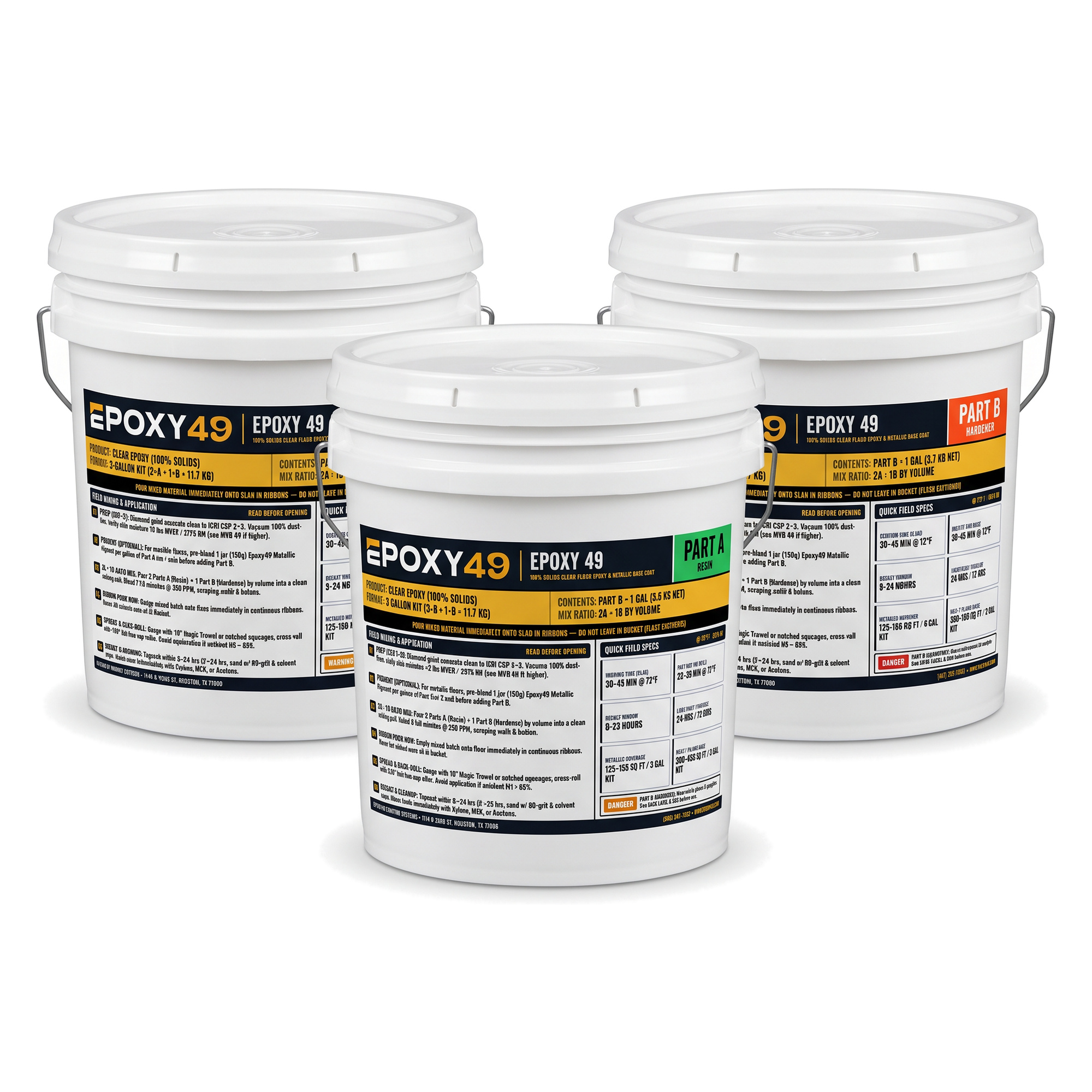
EPOXY 49 — 100% SOLIDS CYCLOALIPHATIC BASE
2A:1B split-bucket 3-Gal Kit ($179.00). Pours at 32–40 wet mils for 3D metallic marble or 12–15 wet mils as a high-bond full-broadcast vinyl flake receiver coat.
Shop EPOXY 49 ($179.00) →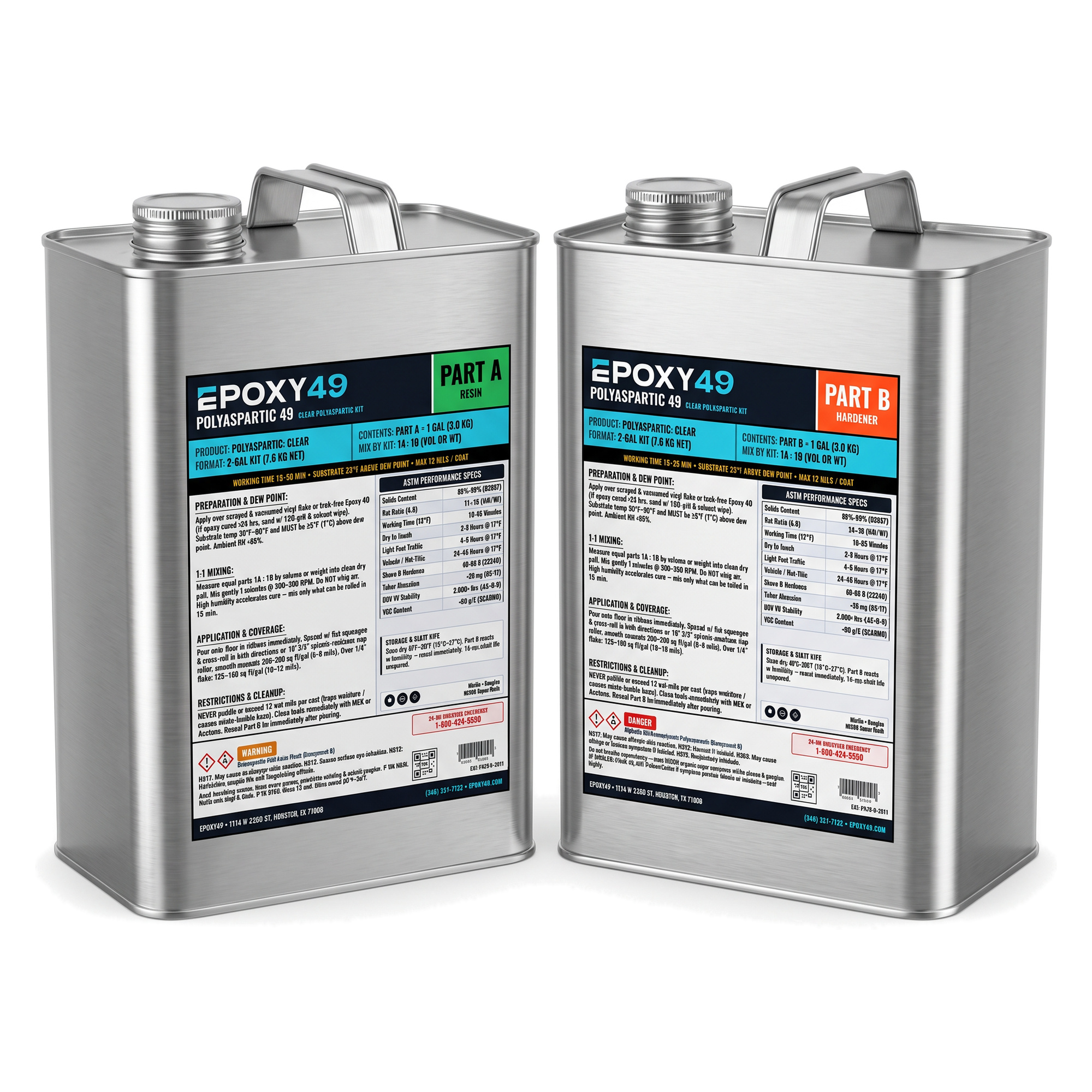
POLYASPARTIC 49 — 99% SOLIDS ALIPHATIC TOPCOAT
1A:1B moisture-sealed 2-Gal Metal F-Tin Kit ($219.00). Cross-rolls at 6–8 wet mils smooth (10–12 mils over flake) for 2-hour dry-to-touch and 24-hour return to service.
Shop POLYASPARTIC 49 ($219.00) →03 / WHEN TO UPGRADE YOUR EPOXY BASE WITH MVB 49
- Dry Sound Garage Slabs (<3 lbs MVER / <75% RH): Prime with PRIMER 49 ($149 / 3-Gal Kit), build with EPOXY 49, and lock with POLYASPARTIC 49.
- Humid, Coastal, Limestone or Irrigated Slabs (3.1–25 lbs MVER / up to 99% RH): Replace standard primer with MVB 49 ($199 / 3-Gal Kit). Essential across Houston, Dallas–Fort Worth, Austin Hill Country, and San Antonio.
04 / FREQUENTLY ASKED QUESTIONS
Is polyaspartic better than epoxy for a garage floor, or should you combine both?
Combining both chemistries in a multi-coat commercial system outperforms either material used alone. A 100% solids epoxy Primer/MVB and EPOXY 49 build coat wet deep into CSP 2–3 concrete pores (30–45 minute working window, >450 psi pull-off, up to 25 lbs MVER vapor suppression with MVB 49), while a 99% solids aliphatic POLYASPARTIC 49 topcoat provides crystal-clear UV immunity (QUV 2,000+ hrs non-yellowing), <25 mg Taber scratch armor, and 140°F hot-tire protection.
Why do "1-Day All-Polyaspartic" franchise garage floors sometimes peel on humid slabs?
Polyaspartic cures rapidly (15–20 minute working time) via an isocyanate reaction that accelerates in high humidity. When applied directly onto bare concrete on a warm afternoon or high-MVER slab, polyaspartic skins over before penetrating concrete capillaries and lacks the <0.10 perm hydrostatic seal of a dedicated 100% solids epoxy moisture barrier like MVB 49.
Can you pour a thick 3D metallic floor using only polyaspartic?
No. Aliphatic polyaspartic must never exceed 10–12 wet mils in a single coat because thick pours trap solvent/moisture cure gas and develop micro-foam haze. True 3D metallic marble depth requires a zero-solvent 100% solids cycloaliphatic build coat (EPOXY 49 at 32–40 wet mils), followed 8–24 hours later by a thin 6–8 mil protective coat of POLYASPARTIC 49.
Why do $150 big-box hardware store epoxy kits peel under hot car tires?
Retail box-store kits contain 50–60% water or solvent carrier. Half the wet thickness evaporates into the air, leaving a brittle 2–3 mil dry film with low crosslink density. Hot tires coming off summer highways at 130°F–140°F soften waterborne binders and rip the film off the slab as the rubber cools and contracts.